The Earth Has a New Buddy
For the past 60 years Earth has had a secret companion and we just noticed! A recently discovered asteroid named 2025 PN7, was first spotted on 29 August by Pan-STARRS 1 telescope (University of Hawaii). Its status was later confirmed by NASA’s JPL horizon service.
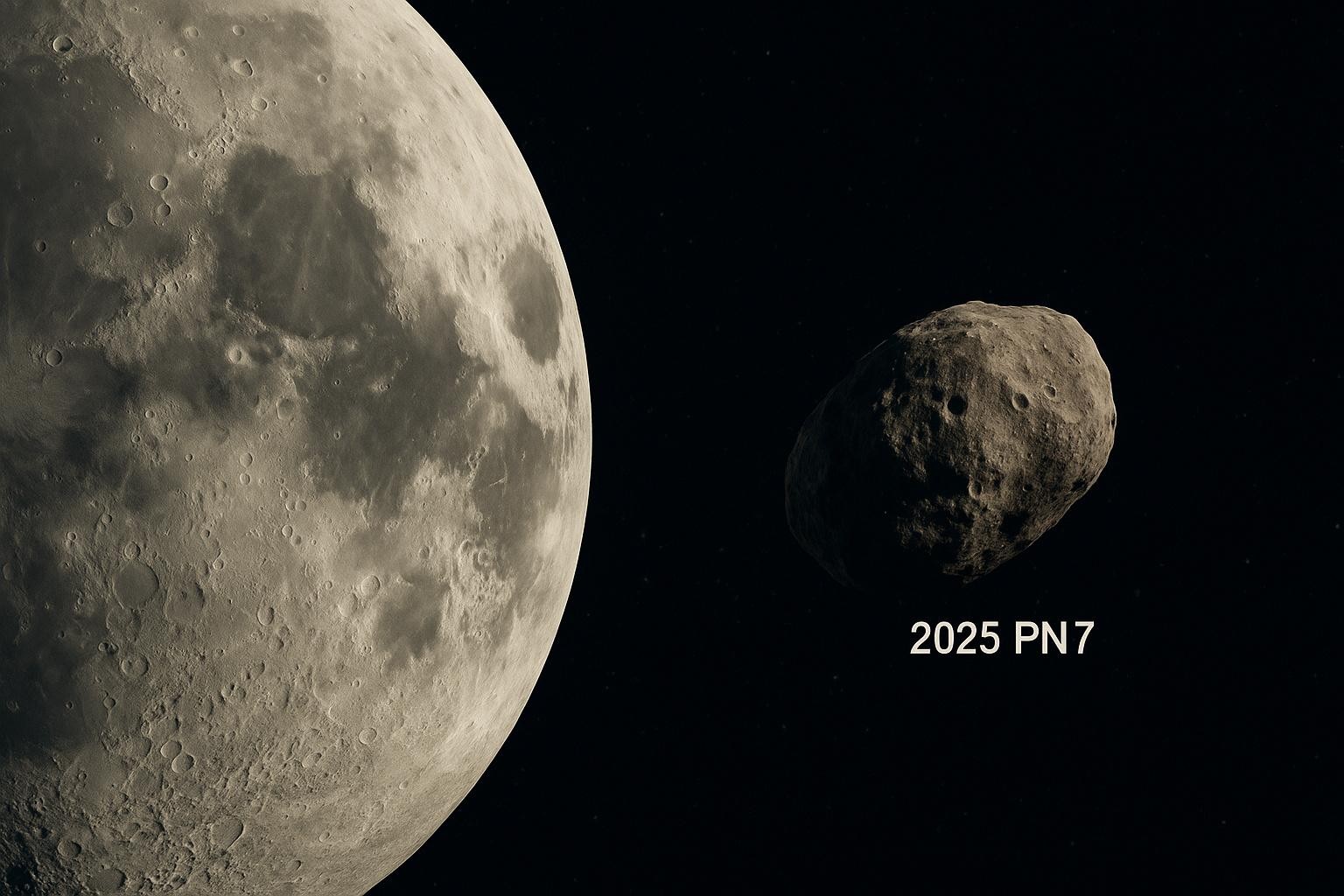
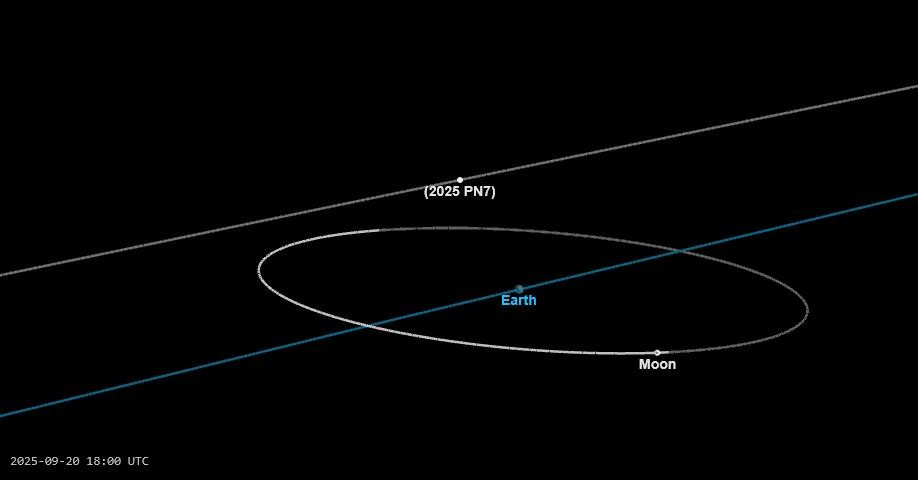
2025 PN7 is a natural object trapped in a 1:1 ratio and is basically a ‘quasi moon’. Quasi moons are objects pretty close to earth but not close enough to experience earth’s gravitational pull. It has been traveling along earth from the 1960s and will keep travelling with us up to 2083 approximately.
Size, Composition and Origin – Where did it come from?
In terms of how it looks, it is a 18–36 metres wide body (roughly the height of four to five storey building). Honestly, pretty tiny as per cosmic standards but significant enough to study and for it to matter to us.
The composition of 2025 PN7 is still unknown. It may be a debris from the main asteroid belt between Mars and Jupiter which found its way to earth or it may be a broken piece of our own moon, we don’t know yet. Currently, the broken moon piece assumption seems to have more weight as the composition of other quasi moons seem to match our lunar profile quite a bit.
Dynamics research found that it is a part of the Arjuna Secondary Asteroid Belt, which is the closest belt to the Earth–Moon system. It actually remains in a 1:1 mean motion ratio which means it is actually orbiting the sun and earth but it creates an illusion which makes it seem like it orbits earth, quite impressive actually.
The Long Time Relationship – 60 Years and Counting
The journey of 2025 PN7 is quite interesting, it has likely entered earth’s vicinity in the 1960s and was finally caught on our radars in August, 2025. The status was formally confirmed in a research paper published by IOP Science in September, 2025.
Our new buddy will leave us behind around 2083 and continue its own journey in a horse-shoe shaped orbit. Its movement around us is caused by quite a gravitational choreography. Our planet’s gravity pulls it back, its speed slows down, it falls back and its speed increases leading to it catching up with us and the process repeats and that’s how it goes for approximately 183 years without being gravitationally bound with us.
It has a magnitude of 26.4, which makes it invisible to naked eyes, binoculars, or telescopes. 2025 PN7 possesses no visible threat to earth and due to its tiny size, even if it falls on earth it will cause a tiny local event rather than a massive national or international one.
A Neighbour We Never Knew we Had
While 2025 PN7 is not a moon in the traditional sense, it is a fascinating, long-term companion and a reminder that even in our immediate cosmic neighbourhood, there is still much to discover.
For sixty years, this ‘secret companion’ traveled silently alongside us, undetected until its discovery in 2025 — a fact that underscores how much of nearby space remains uncharted. As technology improves, we will identify more companions like PN7 and potentially launch missions to explore them, revealing that our solar backyard is far more crowded and interesting than we imagined.
References
- de la Fuente Marcos, C. & de la Fuente Marcos, R. (2025). Meet Arjuna 2025 PN7, the Newest Quasi-satellite of Earth. Research Notes of the AAS (IOP Science / AAS). doi:10.3847/2515-5172/ae028f
- Hollingsworth, J. (2025). Will Earth Have 2 Moons Orbiting It? Astronomers Explain the ‘Quasi-Moon’. ABC News.
- Whitt, K. K. (2025). Meet Earth’s Newest Quasi-Moon, Recently Discovered 2025 PN7. EarthSky.
- Murtagh, R. (2025). 2025 PN7: Characterization, Dynamics, and the Emerging Role of AI in the Study of Earth’s Quasi-Satellites. Zenodo.
- Evon, D. (2025). Does Earth Have a Temporary Second Moon? What Astronomers Actually Discovered. Snopes Fact-Check.