What if the closest alien life isn’t on a distant star far away in the vast universe, but under the ice of a small moon of Saturn?
Enceladus-a small moon of Saturn, is an icy world with geyser-like jets spewing water vapor and ice particles into space. It is the brightest of all Saturn’s moons with a diameter of roughly 500 km, composed almost entirely of water ice with traces of carbon dioxide, ammonia, and light hydrocarbons.
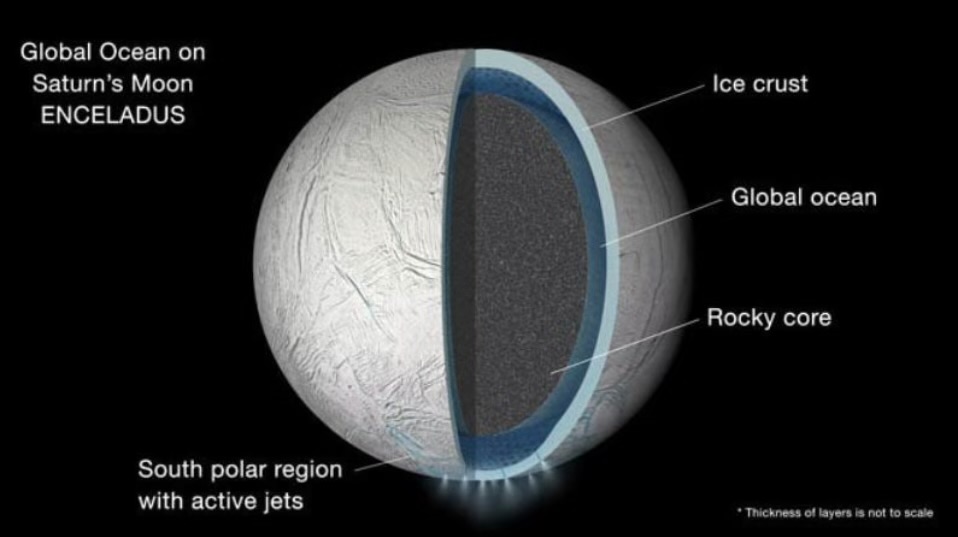
Perhaps the most intriguing thing about this icy moon of Saturn is what lies beneath: a subsurface ocean about 2% of the volume of Earth’s oceans.
The Discovery Beneath the Ice
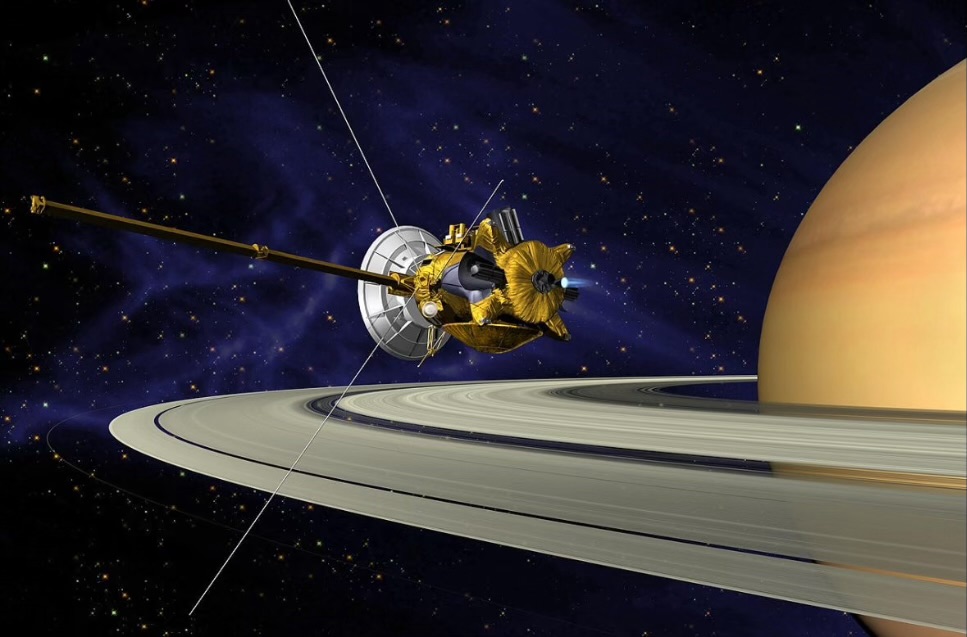
Cassini was a sophisticated robotic spacecraft (at Saturn from 2004 to 2017) sent to study Saturn and its complex system of rings and moons in never-before-seen detail. During its 13 years at Saturn, it produced remarkable data that confirmed a global ocean with strong indications of hydrothermal activity within Enceladus. Enceladus is an active moon with salty liquid water hidden beneath its icy crust.
Before Cassini arrived, scientists knew Enceladus was remarkably bright, but they didn’t know why.
Eruptions Beneath the Ice
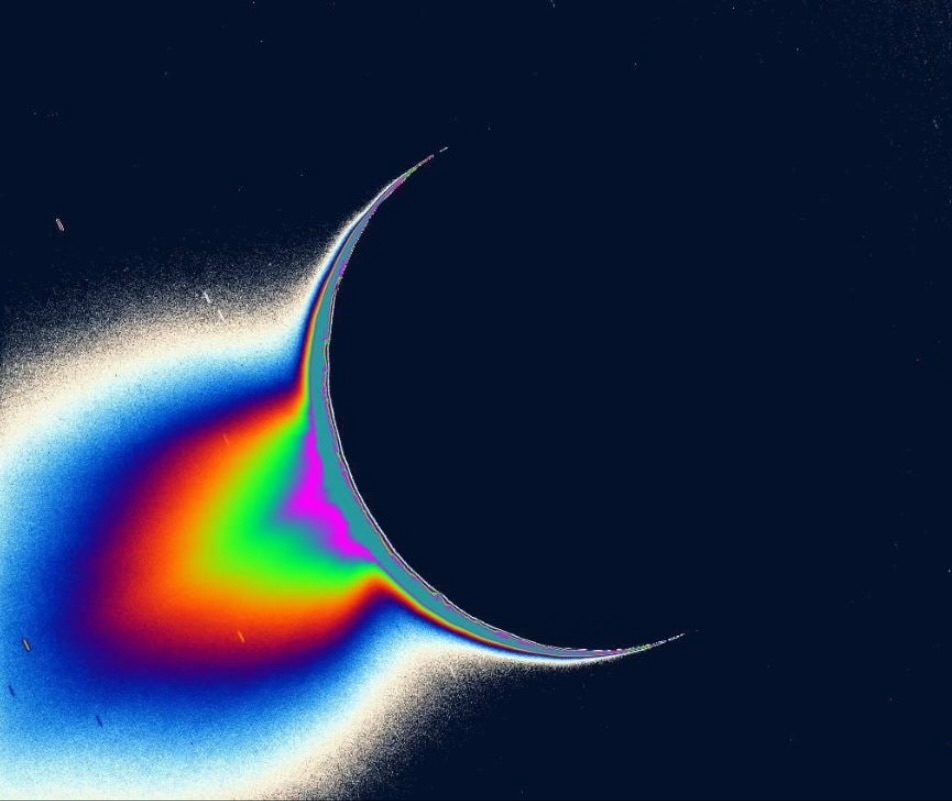
Cassini scientists detected a huge cloud of water vapor spraying into space. They traced it back to warm fractures nicknamed ‘tiger stripes‘ located at Enceladus’s south pole, which continually shoot out water vapor and ice particles. Cassini made a close flyby of Enceladus, passing within 50 km of the moon’s surface. The spacecraft passed through the plumes extending from its southern geysers, detecting water, carbon dioxide and various hydrocarbons with its mass spectrometer.
A 2022 computer model of the plume chemistry suggests that the ocean is moderately alkaline with a pH between 7.95 and 9.05 (though other studies estimate it could be more alkaline). What’s more, scientists believe the ocean is rich in carbon dioxide and hydrogen—the exact chemical diet needed to feed microscopic life. On Earth, microbes called methanogens use these gases for energy and release methane.
On December 14, 2023, scientists announced they had found hydrogen cyanide for the first time in the plumes of Enceladus. This chemical is a key building block for life as we know it, along with other organic molecules that scientists are still working to identify.
Why Enceladus Could Support Life?
Scientists think life needs three things: liquid water, a source of energy, and chemical building blocks like carbon, hydrogen, nitrogen and oxygen. Enceladus appears to have all three.
Many worlds have one or two of these ingredients, but only a few appear to have all three of them like Enceladus. Scientists found that Enceladus’s ice grains (Small, crystalline particles of ice) contain a rich array of minerals and organic compounds—including the ingredients for amino acids—associated with life as we know it.
Enceladus has its own source of energy, which makes it extraordinary. Far from the Sun’s warm light, that energy comes from deep within. Evidence suggests that on its rocky ocean floor, hydrothermal vents spew heat and nutrient-rich minerals into the water.
On Earth, deep-sea vents are packed with thriving ecosystems that never see a single ray of sunlight—proving that life doesn’t always need the Sun, just warmth and chemicals.
Because Enceladus has likely had a stable, chemical-rich ocean with warm vents for millions of years, it isn’t just an interesting icy moon—it is one of the most promising places in our solar system to look for life beyond Earth.
New Evidence in the Search for Life on Enceladus
Scientists are no longer just guessing about what might be hiding beneath the ice, they are actively experimenting with it in laboratories.
To see if life could actually survive in the moon’s unique environment, scientists were able to reproduce the conditions of Enceladus’s ocean in a laboratory. After recreating the conditions, including its hydrothermal interaction with the rocky ocean floor, they introduced Methanothermococcus okinawensis into the contained environment. This microorganism is a methane-producing microbe that normally lives near deep-sea hydrothermal vents on Earth. It does not need oxygen to survive. Instead, it relies on hydrogen and carbon dioxide.
The results were astonishing: in the Enceladus simulant it continued to grow, taking in hydrogen from its surroundings. Under the simulated Enceladus conditions, the microbes were even able to adapt to the low amounts of carbon dioxide. This does not mean life exists on Enceladus. It only shows that an Earth microbe could survive in conditions like its ocean.
Beyond survival experiments, a study led by researcher Frank Postberg has revealed a fascinating discovery about the plumes themselves. Previously, scientists assumed that water droplets blasting out through the moon’s fractures into space at up to 1,000 kilometers per hour would freeze instantly. Instead, researchers discovered that these droplets freeze much more slowly. As the spray travels and collides with the walls of the tiger stripes, the gradual cooling and fragmentation causes organic and inorganic materials to separate.
This means future spacecraft could analyze individual ice grains and, if life exists there, find traces of it more easily.
Does Enceladus Hold Life?
While the latest discoveries are exciting, none of them confirms that life exists on Enceladus.
As researcher Frank Postberg said, “that doesn’t mean that there is life on Saturn’s moon.”
Together, these discoveries address two crucial practical questions—whether a future space mission could successfully detect signs of life in the plumes, and whether the chemistry of Enceladus’s ocean can support Earth-like microbes.
Cassini detected methane in the plumes of Enceladus, but whether it comes from living organisms or from purely geological reactions remains a mystery. Showing that a microbe could make methane in such conditions does not prove that microbes actually do so on Enceladus.
What these studies do show is that Enceladus isn’t just a lifeless sphere of ice. We have found strong signs of a potentially habitable ocean; now it’s up to future missions to find out whether anything lives there.
Future missions heading to Enceladus
NASA has studied a flagship concept called the Enceladus Orbilander, which would spend about a year and a half orbiting the moon and sampling its plumes before landing on the surface for a two-year mission to search for evidence of life. For now, it remains only a proposal.
Meanwhile, the European Space Agency (ESA) is studying its own mission called L4, which would send an orbiter and a lander to Enceladus. L4 is still in the planning stage, with a launch expected around 2042 and a landing around 2058.
Neither mission has been fully approved yet, and both are decades away from reaching Enceladus. Until a spacecraft arrives, the question stays open.
References
- Enceladus | NASA Science
- Details of Enceladus’ Subsurface Ocean | Astrobiology at NASA
- Cassini–Huygens – Wikipedia
- Enceladus | Geology, Plumes & Eruptions | Britannica
- Water plumes from Saturn’s icy moon Enceladus… | The Planetary Society
- Two New Enceladus Studies Suggest a Spacecraft Could Detect Signs of Life More Easily, If Any Exist
- Great News from Saturn’s Moon Enceladus in the Search for Life in Space • Information for Media and Journalists • Freie Universität Berlin
- Microbes could survive on Saturn’s moon Enceladus — and scientists think we can find them | Space
- COSMOS Timeline and status – L4 – Cosmos
- L4 to Enceladus – ESA Science Programme