A few weeks ago, I went down a rabbit hole that I genuinely could not climb out of. It started with one question – what exactly is dark matter? – and it ended with something that changed how I see the universe, my existence, and honestly, my morning coffee. Here is everything I found.
The 27% Nobody Is Talking About
Let’s start with something that should probably bother you more than it does.
Everything you have ever seen, touched, tasted, or experienced – every mountain, every ocean, every star you have ever looked up at, every person you have ever loved – all of that adds up to roughly 5% of the total universe.
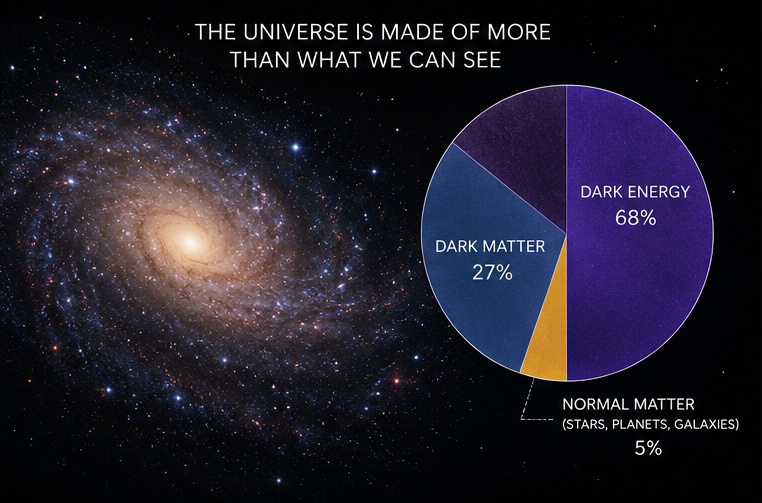
The remaining 95% is made up of two things we do not fully understand: dark energy, which is driving the universe apart at an accelerating rate, and dark matter – the subject of this blog and the reason any of this exists at all.
Dark matter makes up approximately 27% of everything in the universe. That makes it five times more abundant than all the normal, visible matter combined.
And yet, as of today, no laboratory instrument has ever directly detected a single dark matter particle. We have never seen it. We have never touched it. It emits no light, reflects no light, and does not interact with electromagnetic forces at all – which is precisely why it is invisible to every conventional tool we have.
“We have never seen dark matter. We have never touched it. And yet it is five times more abundant than every star and galaxy combined.”
So how do we know it is there?
The same way you know the wind exists when you are standing in a storm. You cannot see the wind itself. But you can see what it does to everything around it.
Dark matter reveals itself through gravity. And the evidence for it, once you start looking, is everywhere.
In the 1930s, Swiss astronomer Fritz Zwicky was studying the Coma galaxy cluster when he noticed something deeply wrong. The galaxies at the outer edges of the cluster were moving far too fast. By every calculation available, they should have been flung out into the void long ago.
The visible matter inside the cluster simply did not generate enough gravitational pull to hold them together. Something else was holding everything in place – something massive, invisible, and unaccounted for. Zwicky called it dunkle Materie (Dark matter)
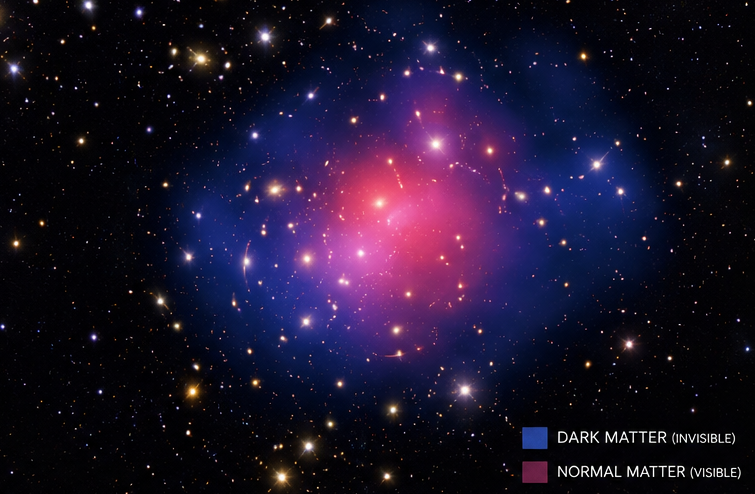
Decades later, in the 1970s, astronomer Vera Rubin confirmed the same problem on a galactic scale. Stars at the outer edges of spiral galaxies were orbiting just as fast as stars near the centre – which should be physically impossible if the only gravitational source was the visible matter we could see. The outer stars should have been moving far slower. The only explanation that held up was the existence of an enormous invisible halo of mass surrounding every galaxy.
That halo is dark matter.
We have since confirmed its existence through gravitational lensing – watching dark matter bend the light of distant galaxies around it – and through the cosmic microwave background, the faint afterglow of the Big Bang, which shows the fingerprints of dark matter’s influence on the earliest structure of the universe. We know it is there. We know what it does. We just do not yet know precisely what it is.
The leading candidates are particles called WIMPs – weakly interacting massive particles – and a theoretical particle called the axion. Neither has been detected directly yet, and some of the world’s most sophisticated experiments are currently running deep underground, in near-perfect silence, listening for the faintest sign of a dark matter particle passing through.
What If Dark Matter Had Never Existed?
This is the question that stopped me cold.
Not in a frightening way – in the way a really good puzzle stops you. Because the answer is not just “things would be different.” The answer is far more absolute than that.
To understand it, we have to go back to the very beginning.
In the first fractions of a second after the Big Bang, the universe was extraordinarily hot, extraordinarily dense, and crucially extraordinarily smooth. Matter was distributed almost perfectly evenly in all directions. There were no clumps. No clusters. No structure of any kind.
And here is the problem with a perfectly smooth universe: it stays smooth.
In a universe with no dark matter, the tiny quantum fluctuations that existed in the early universe—microscopic differences in density smaller than anything measurable—would have been washed out.
Radiation pressure from the hot plasma of the early universe would have smoothed everything back out before gravity ever had a chance to pull matter together.
No clumps. No clouds. No stars.
Just a slowly expanding, perfectly even, utterly featureless sea of hydrogen and helium gas – thinning out forever, in complete and permanent darkness.
“A smooth universe is a dead universe. No stars, no planets, no life. Just endless, empty, silent nothing. Forever.”
This is not speculation. The Millennium Simulation, a landmark computational model developed by the Max Planck Institute for Astrophysics, modelled the large-scale structure of the universe across billions of years. When dark matter is included in the model, the universe that emerges looks exactly like the one we observe – a vast cosmic web of filaments and clusters, galaxies threading along invisible scaffolding like dew on a spiderweb.
Remove dark matter from the model, and the web collapses. Structure does not form. The universe stays smooth, empty, and dark. Permanently.
This is where chaos theory enters the picture in a way that is genuinely difficult to shake.
Chaos theory tells us that tiny differences in initial conditions can lead to wildly different outcomes—the famous butterfly effect, where a small change at the beginning compounds into something enormous over time.
What dark matter did, in the very early universe, was amplify those tiny quantum ripples instead of letting them be smoothed away. Its gravity pulled normal matter into those microscopic fluctuations. Small density differences became slightly larger density differences, which became clouds, which collapsed into the first stars, which gathered into galaxies.
The butterfly that flapped its wings was a quantum ripple smaller than anything we can measure. The hurricane that followed was the entire structure of the observable universe.
Would We Have Ever Existed?
Let’s follow the chain to its conclusion, because this is where it gets genuinely humbling.
Dark matter seeded the first structures in the universe. Those structures collapsed into the first stars – enormous, short-lived giants that burned brilliantly and then exploded as supernovae, scattering heavy elements across space for the first time. Before those stellar explosions, the universe contained only hydrogen and helium. After them, it contained carbon, nitrogen, oxygen, iron – the building blocks of everything complex.
Including you.
Every carbon atom in your body was forged inside a star that died before our sun was born. Every atom of oxygen in your lungs, every iron molecule in your blood – all of it came from stellar explosions made possible by the gravitational structure dark matter built.
Without dark matter holding early matter together long enough for the first stars to form, there are no supernovae. Without supernovae, there are no heavy elements. Without heavy elements, there is no chemistry complex enough to produce life. Without life, the question of our existence does not even get asked.
“Every carbon atom in your body was forged inside a star that died before our sun was born. You are, in every literal sense, a product of dark matter.”
Our solar system formed approximately 4.6 billion years ago inside a particular arm of the Milky Way, held in stable orbit within our galaxy by the dark matter halo surrounding it. Earth formed at a specific distance from our sun – the habitable zone, where liquid water can exist on a surface. Water, which requires oxygen, which requires a dead star.
The conditions that make this planet habitable are not accidents. They are the downstream consequence of a series of events that began with dark matter pulling the first threads of structure out of a featureless void.
So – would we have existed without dark matter?
The honest answer is no. Not in any form we would recognise. Not on any planet we could identify. The conditions required for life as we understand it – a stable galaxy, a sun-like star, a rocky planet at the right distance with liquid water and complex chemistry – all of these required the gravitational scaffold that dark matter built and continues to maintain.
We are not just living in a universe shaped by dark matter. We are, in a very real sense, the product of it.
From Cosmic Webs to Morning Coffee
Here is the part that keeps researchers awake at night – in the best possible way.
We still do not know what dark matter actually is. Every candidate particle remains undetected. Every experiment has returned a null result. And yet, the gravitational evidence is so overwhelming that almost no serious physicist doubts its existence. Something is out there. We just do not have the tool yet to see it.
New experiments – including the LUX-ZEPLIN detector deep inside a former gold mine in South Dakota, and the XENONnT experiment beneath Italy’s Gran Sasso mountain – are currently running, listening for the faintest whisper of a dark matter particle making contact with normal matter.
Meanwhile, the James Webb Space Telescope is giving us our deepest view of the early universe yet, allowing cosmologists to study the very moments when dark matter’s influence first shaped the cosmic web we live in today.
We are getting closer.
We are getting closer to the truth. And when we finally understand what dark matter actually is, it will be more than a scientific breakthrough—it will be a moment of profound recognition. It will mean we have finally seen the invisible hand that forged the stars, built the galaxies, and ultimately, made your morning coffee possible. We aren’t just observers of the universe; we are deeply, invisibly connected to its very foundation.
Does knowing that you are a product of dark matter make the universe feel lonelier, or more connected? Let me know in the comments.
References
- Black Matter | NASA
- Hubble’s Sweeping View of the Coma Cluster of Galaxies | NASA
- Vera Rubin and Dark Matter | American Museum of Natural History
- Max Planck Institute for Astrophysics
- The LZ Dark Matter Experiment
- XENON Dark Matter Project