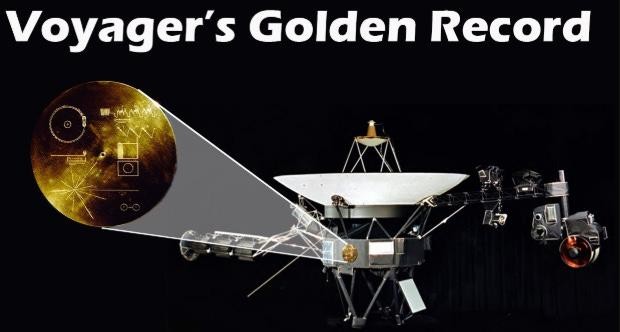
The Golden Record is a Phonograph Record containing sounds, images and information representing life on Earth which was attached to both Voyager I & Voyager II and launched in 1977.
Not an Ordinary Record
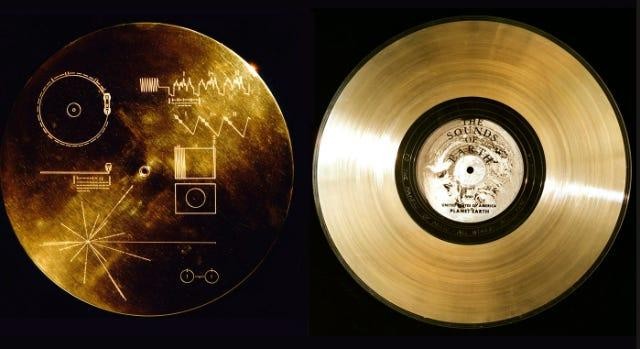
The Voyager Golden Record is a 30 cm (diameter) disc made of copper, coated with a layer of gold for durability. It is stored inside a protective aluminum cover, designed to shield it across billions of years in space.
On the record’s cover, a small patch of ultra‑pure Uranium‑238 was electroplated. This patch acts as a radioactive clock which makes it easier for extraterrestrial species who will discover Voyager I or Voyager II to calculate how much time has passed since its launch.
Alongside this, the cover carries engraved diagrams that act as instructions written not in ordinary language, but in universal language of physics—codes that any advanced civilization could understand.
Messages Engraved
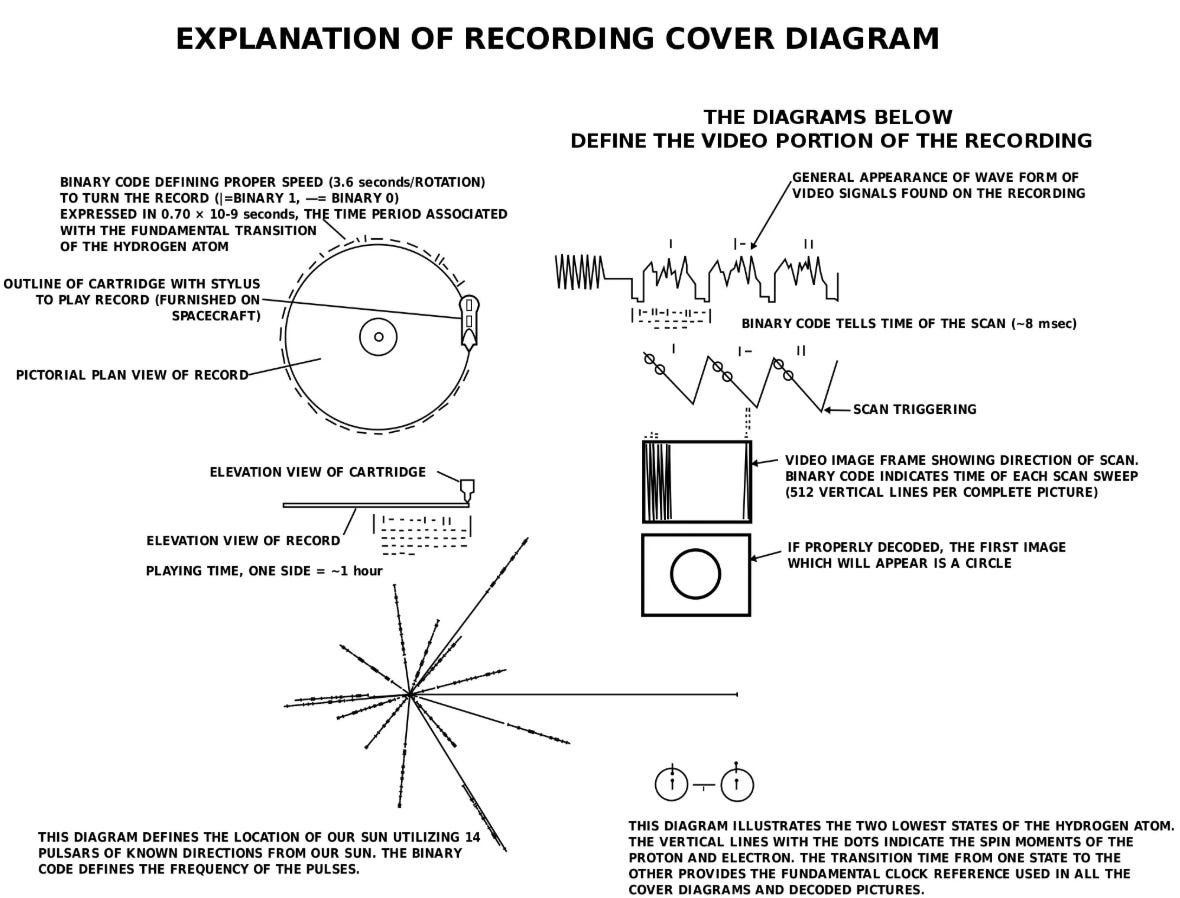
On the surface of the Golden Record, instructions and some codes were written about how to use the disc, how to play it at correct speed, and even a pulsar map explaining where we live. Along with the Golden Record, a phonograph cartridge and stylus were attached near it.
Image credits: NASA
Image credits: NASA
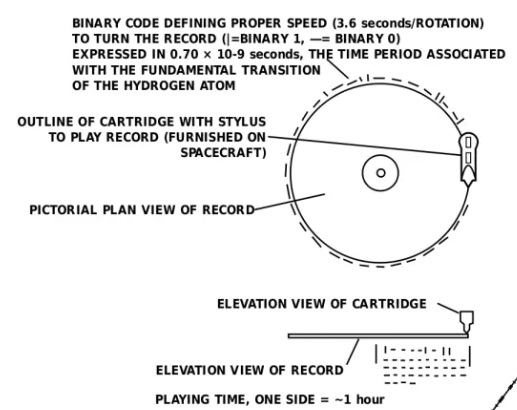
In the upper left corner, a drawing of the phonograph record and the stylus was engraved. Written around it in binary arithmetic is the correct time of one rotation of the record, 3.6 seconds, expressed in time unit of 0.70 billionths of a second.
Just below this drawing, there’s a side view of the record and stylus. A simple binary number is shown, saying that one side of the record plays for about an hour.
Image credits: NASA
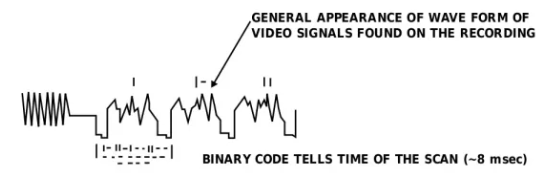
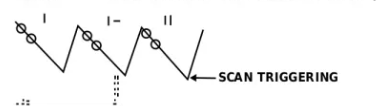
On the top right corner, the drawing engraved shows the waveform of signals. Picture lines 1, 2 and 3 are marked in binary numbers to guide the sequence of images.
Image Credits: NASA
The drawing above shows how the lines are arranged vertically using staggered interlacing (a method where odd lines are drawn first and even lines later), to create clear and smooth images.
Image Credits: NASA
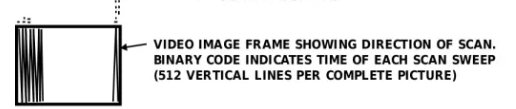
This drawing shows a complete picture raster (full layout of an image made up of scan lines), showing that each image is composed of 512 vertical lines.
Image Credits: NASA
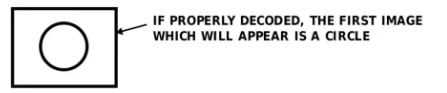
The image shown above is the replica of the first image on the record, it is included so that extraterrestrial species can confirm that they are decoding the signals correctly.
Image credits: NASA
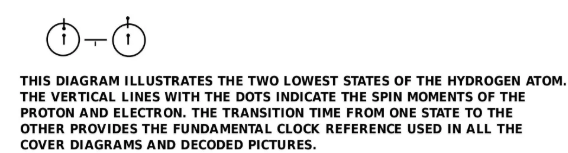
On the bottom right corner, the drawing shows two circles which represent hydrogen atoms at their lowest energy levels, with a connecting line and digit I to indicate the time interval for the transition between two basic energy states of the hydrogen atom. This tiny and precise transition was chosen by scientists as the fundamental unit of time for the Golden Record since the instructions engraved on the cover provided a way to measure playback speed, and correctly decode the images and sounds stored on the record.
Image credits: NASA
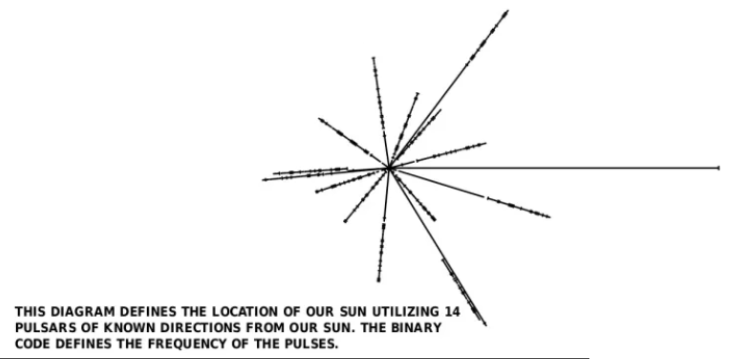
On the bottom left corner of the cover, a pulsar map is given describing the position of our solar system in relation to 14 pulsars since each pulsar is labeled with its own precise period. The binary code written with each pulsar on the cover defines the frequency of the pulses.
Image Credits: NASA
Messages Stored
Let’s understand about the data that Carl Sagan and his team selected to represent Earth’s diversity and the story of humanity.
Carl added 116 images to the record including the first image that is also engraved on the cover, covering everything like basic mathematics, images of planets like Saturn, natural view, plants, animals, images of humans, pregnant women, DNA, human anatomy, humans consuming food. He didn’t include the images of war, violence, poverty, etc; because he wanted to show the best sides of humanity to the extraterrestrial species who will find Voyager I or Voyager II.
Carl and his team also added natural sounds like thunder, ocean waves, wind, birds chirping, animal sound, and whale songs. They also added musical selections from different cultures and eras.
The Voyagers were never meant to go to a particular planet or a star; they are only drifting slowly in the interstellar space. It will never find intelligence, only intelligence will find it. It will take nearly 40,000 years before it even comes close to another star system. Yet the record is built to survive and preserve the message of humanity for over a billion years. Whether it is ever found or not, the Golden Record is meant to preserve the proof that humanity existed even if we disappear someday in the future.